Dresden in a Day
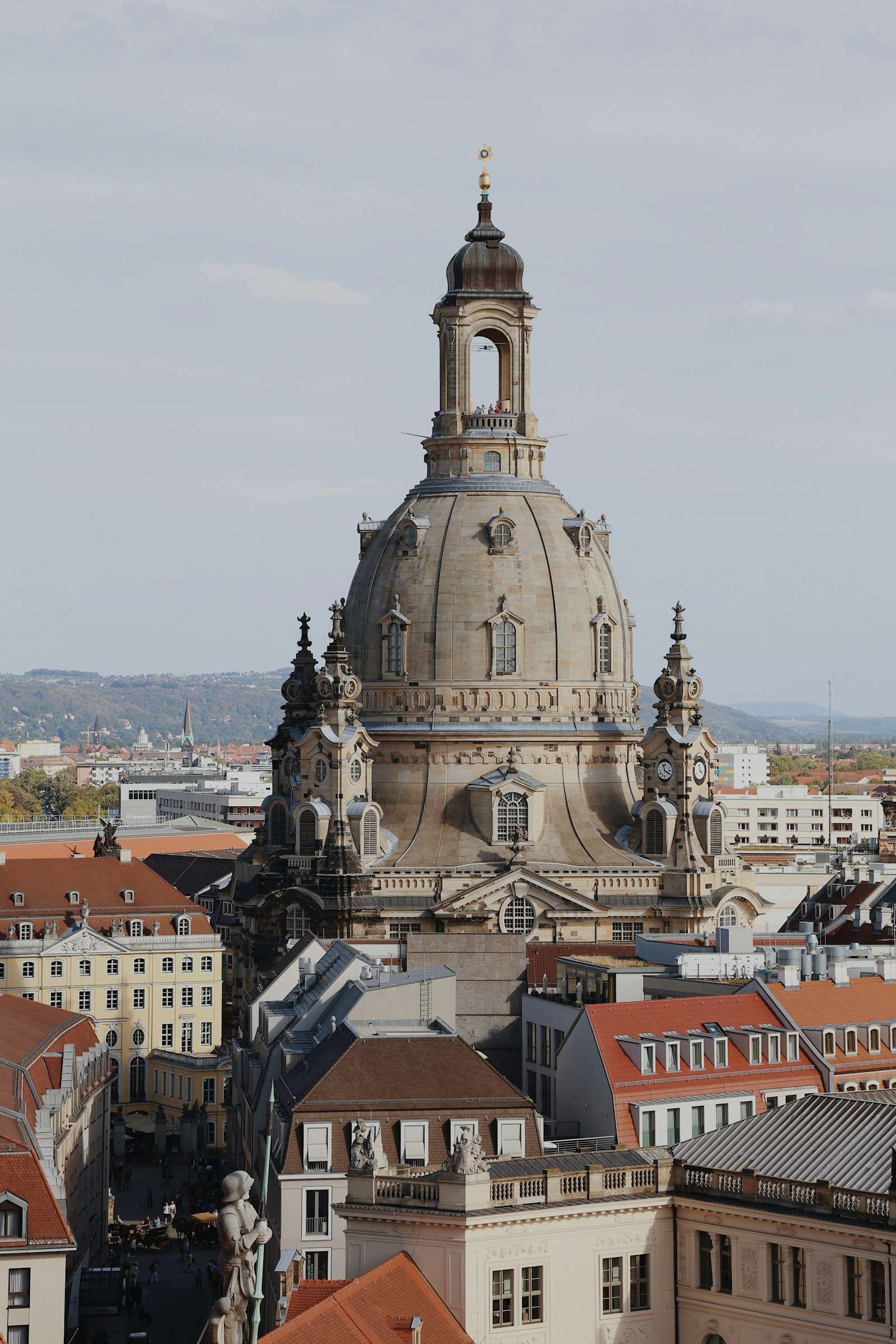
Two hours south, the baroque city that burned in a single February night stands rebuilt — the dark stones in the Frauenkirche’s walls are the originals, returned to where they fell from. Take the early train and read the city plainly.
The short version
- EC and regional trains run Berlin Hbf to Dresden in about two hours at steady frequency — the alarm’s early departure buys the full day; times at bahn.de, with the old town fifteen minutes’ walk from the Hauptbahnhof.
- The historical frame, stated straight: the Allied firebombing of 13–14 February 1945 destroyed the baroque center and killed some 25,000 people; the city you walk is reconstruction — decades of it, some GDR-era, much post-1990 — and the rebuild is itself the story.
- The Frauenkirche stood as a rubble mound for fifty years by deliberate GDR memorial policy, then rose again 1994–2005 using every salvageable original stone — the dark blocks scattered through the pale new walls are the alarm’s fact, placed back at their documented positions; visitor details at frauenkirche-dresden.de.
- The dome climb inside the Frauenkirche delivers the rebuilt skyline whole; the church floor below runs free entry at posted visitor hours around its service schedule.
- The Zwinger’s courtyard and pavilions cost nothing to wander; its Old Masters Gallery (around €14) holds Raphael’s Sistine Madonna — the two bored cherubs at its base are the world’s most quoted supporting cast — with Vermeer and the porcelain collection alongside.
- The Fürstenzug — 102 meters of Saxon rulers in 24,000 Meissen porcelain tiles, and a survivor of the firestorm — reads free along Augustusstrasse per the alarm; Brühl’s Terrace, the Semperoper’s facade, and the Residenzschloss’s Green Vault treasuries complete the circuit.

Getting there
The early Berlin departure per the alarm is the day’s whole architecture — arrival by mid-morning, the compact old town walked without hurry, and the evening train home after an early dinner. The Elbe-side approach from the station sets the register: the rebuilt skyline assembling across the water exactly as the painters had it. Green Vault ambitions need advance timed tickets (the historic vault sells out); everything else in the day runs turn-up. Regional-fare tickets undercut the EC at the cost of minutes; the arithmetic favors whichever leaves earliest.
The day
Frauenkirche first: circle the exterior reading the dark-stone mosaic of original and new, then the interior’s pale lightness and the dome climb’s skyline. The Neumarkt around it is reconstruction at its most complete — photograph it knowing the date of everything. The Fürstenzug walk leads to the Residenzschloss (the Green Vaults for the booked, the armory for the rest) and on to the Zwinger: the courtyard’s baroque theater free, the Sistine Madonna’s room the paid hour that anchors the museum half. Lunch runs Saxon — sauerbraten, or the Neustadt’s cafés for the lighter register. The afternoon takes Brühl’s Terrace’s balcony above the Elbe, the Catholic court church, and — for the second Dresden — the tram across the river to the Neustadt’s lived-in streets, where the city stops being a monument. The evening train carries a day that reads differently than it photographs, which is the point.
When to go
April to June and September to October give the baroque stone its walking weather and the Elbe terraces their light. December’s Striezelmarkt — among Germany’s oldest Christmas markets — dresses the rebuilt squares in their best argument, at booked-train density. February 13th marks the destruction’s anniversary with bells and human chains: a moving date to witness deliberately, not stumble into. Summer runs full but absorbs it; the Old Masters’ air conditioning is the heatwave refuge the ticket includes.
Frequently Asked Questions
How much of what I see is original?
Varies by building and honestly signed: the Zwinger and Semperoper were rebuilt in the GDR decades, the Frauenkirche and Neumarkt after 1990, and the dark stones, surviving cellars, and the Fürstenzug’s tiles are the genuine threads. The city doesn’t pretend otherwise, and reading the seams is the visit’s depth.
Is the firebombing memorialized directly?
The Frauenkirche functions as the memorial — its altar cross was made by a British silversmith whose father flew in the raid, and the church’s mission is explicit reconciliation. The anniversary observances and the museum contexts carry the rest. The register is remembrance without spectacle, and visitors match it.
Do I need the Green Vault ticket?
The Historic Green Vault (timed, advance, limited) is the treasury-room spectacle; the New Green Vault sells same-day for the objects without the chamber theater. Jewel-inclined travelers book ahead; the Sistine Madonna needs no reservation and anchors the museum case regardless.
Dresden or Potsdam from Berlin?
Potsdam (documented on this network) for palaces and parks at S-Bahn distance; Dresden for a whole second city at two hours. Half-day versus full-day commitments — Dresden repays the longer train with the bigger story.
Is the Neustadt worth crossing the river?
For the counterweight, yes — the Kunsthofpassage’s painted courtyards, the bar streets, and ordinary Dresden living its evening. An hour there recalibrates the old town from stage set back to city. Skip it only when the train math truly forbids.