Luther’s Wittenberg
Under an hour on the fast train, the town where the Reformation began — the door you photograph is an 1858 bronze, the wooden original burned in 1760, and whether Luther nailed anything at all is argued. The theses were real either way.
The short version
- Trains run Berlin to Lutherstadt Wittenberg in about 40 minutes by ICE or roughly 1h20 by regional (bahn.de) — the fast-one clause per the alarm is real money’s worth — with the old town a fifteen-minute walk or short bus from the station.
- The 1517 headline stated per the alarm: Luther’s Ninety-five Theses against indulgences launched the Reformation from this town — the famous nailing to the Schlosskirche door is tradition rather than documented certainty, the wooden doors burned in 1760, and the doors there now are the 1858 bronze pair cast with the theses’ full Latin text.
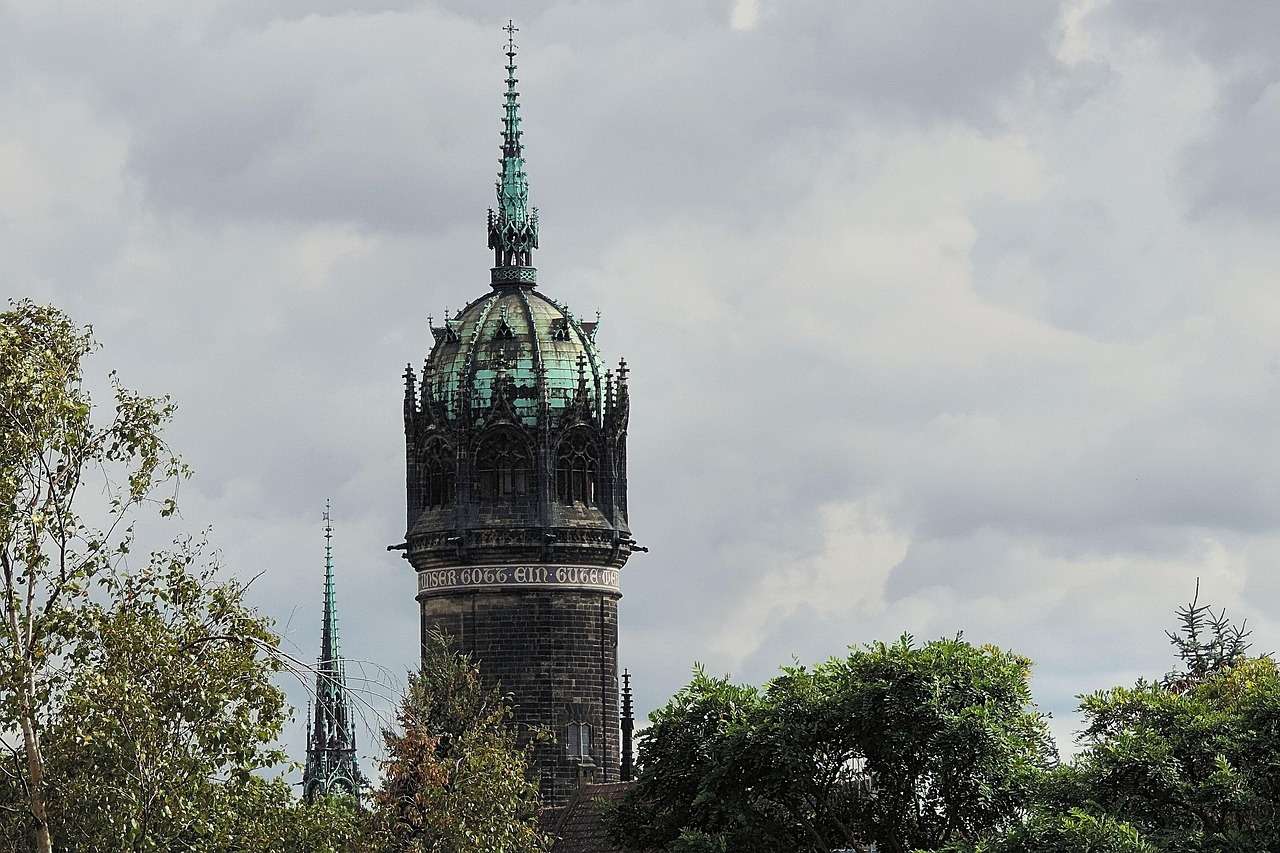
- The Schlosskirche (Castle Church) holds Luther’s and Melanchthon’s graves beneath the pulpit’s descendants, with the tower climb adding the town-and-Elbe panorama for modest steps and fee.
- The Lutherhaus — the former monastery Luther lived in as monk and then as family man, and the anchor Reformation museum — carries the alarm’s standing hedge: a long renovation has limited what shows and where, and checking current opening status (lutherstadt-wittenberg.de) precedes building the day around it.
- The Stadtkirche St. Marien — where Luther actually preached hundreds of sermons and the Reformation’s first services in German were held — keeps the visit’s best art: the Cranach altar, painted by Luther’s friend Lucas Cranach the Elder with the reformers portrayed inside the sacred scenes.
- The Cranach courtyards round the circuit: the painter-pharmacist-mayor’s workshop complexes, working studios and exhibits today, plus Melanchthon’s house museum for the movement’s scholar — the whole town walking flat along one street per the glance.

Getting there
The ICE-versus-regional fork is the alarm’s catch-the-fast-one clause: the ICE’s forty minutes make Wittenberg an easy half-day, the regional’s eighty make it a committed one, and both land the same station. The town’s geometry is a gift — Collegienstrasse and Schlossstrasse form one axis with Lutherhaus at one end and Schlosskirche at the other, everything between. The Lutherhaus status check per the alarm happens before departure; the town’s substance survives either answer, but the day’s shape changes.
The day
Start at the Schlosskirche end: the bronze doors read plainly per the alarm — the theses’ text in your hands, the 1760 fire and 1858 recasting told by the plaque, the nailing tradition held as tradition — then the church’s interior for the graves and the tower for the view. Walk the axis: the market square’s Luther and Melanchthon statues under the town hall, the Stadtkirche’s Cranach altar taken slowly (the reformers at the Last Supper, Cranach himself among them — the Reformation painting its own portrait), and the Cranach courtyards’ workshop layers. The Lutherhaus end delivers whatever the renovation allows — the museum whole, the interim exhibits, or the exterior and garden — with Melanchthon’s house as the reliable scholarly counterpart next door. Lunch runs Saxon plain (Wittenberger specialties lean bratwurst and honest cake). The return train makes Berlin by evening with the fast connection doing it in less time than the museum debate took.
When to go
April through October runs the town at walking temperature with full church and museum hours. October 31 — Reformation Day — is the singular date: the anniversary of the theses, marked with services, festival stalls, and the town at its most itself; the 500th in 2017 rebuilt much of the visitor infrastructure the town still enjoys. Advent dresses the market square modestly and honestly. Winter thins hours; the churches persist. Any season, the Lutherhaus check per the alarm decides more of the day than the weather does.
Frequently Asked Questions
Did Luther actually nail the theses to the door?
Argued, per the alarm: the earliest account comes from Melanchthon, written after Luther’s death and not as an eyewitness; Luther’s own letters document mailing the theses to church superiors on October 31, 1517. Many historians accept a posting (the door served as the university’s notice board), others doubt it. The theses, the date, and the consequences are certain; the hammer is tradition.
What happened to the original door?
The wooden doors burned in 1760 during the Seven Years’ War bombardment. In 1858 Prussia’s king donated the bronze pair standing today, cast with the complete Latin theses — a monument wearing the text it commemorates. Photographing them as ‘the door’ is fine as long as you know what you’re holding, which is the alarm’s whole point.
Is the Lutherhaus worth it during renovation?
It depends on what’s open when you go — hence the standing check. The collection (the world’s largest on Reformation history) has shown in partial and interim forms through the works. The Stadtkirche’s Cranach altar and the Schlosskirche cost nothing in planning risk and carry the day regardless.
What’s special about the Cranach altar?
Lucas Cranach the Elder — Luther’s close friend, wedding witness, and the Reformation’s image-maker — painted the reformers into the sacraments themselves: Luther preaching, Melanchthon baptizing, the congregation full of real Wittenberg faces. It’s the movement’s self-portrait at the moment of its victory, hanging where it was made for.
Wittenberg or Potsdam from Berlin?
Potsdam (documented on this network) for Prussian palaces and park splendor at S-Bahn distance; Wittenberg for world-historical weight in a small Saxon town. Sanssouci’s gardens versus the Reformation’s front door — different centuries, different registers, and the fast train makes Wittenberg the easier half-day of the two.